Where Vernon Hills Got Its Name, and Where to See It Today
November 19, 2026
November 19, 2026
In 1958 the people trying to turn about twenty new homes into a village wanted to call it Forest Hills. The name matched their three streets: Forest Court, Forest Way and Oak Forest Lane. They were asked to choose something else because too many towns in the area already had "forest" in their names. Builder Barnie Loeb told the Village in a 2003 interview how the second choice came about. "Vernon" came from the township. "Hills" came from a mound that he and his partner, Quinn Hogan, had built on the seventh hole of the Tally Ho Golf Course.
So a hill on a golf course gave Vernon Hills its name. The course is still open on Evergreen Drive, and the Village owns it. Two other places shaped the town: the mall that turned it into a real town, and the farm estate whose land became its north end. Both are still there, and both have their own news this holiday season.
The village started as a builder's project. On January 4, 1957, the Lake County Board of Supervisors sold 120 acres just south of Route 45 and Butterfield Road to Barney Loeb and Quinn Hogan, joint owners of L&H Builders of Mundelein, for $60,000. That was roughly $596,000 in 2022 dollars, according to the Cook Memorial Public Library District's local history post. L&H had just finished building Streamwood. By August 31, 1957, twenty homes stood on the land, and the forty-one residents filed a petition to incorporate.
Voters approved incorporation 45 to 1 in July 1958, and L&H manager Matt Teolis became the first village president. Many of the residents worked for L&H, so the Lake County State's Attorney suspected the company would use the new village to avoid taxes. In late 1958 he accused the trustees of holding "pretended offices." The Illinois Supreme Court ruled on September 29, 1960, that there was no evidence L&H controlled Vernon Hills.
The village counted 123 people in 1960 and 1,050 in 1970. The library history describes Vernon Hills at that point as little more than a handful of homes, the Tally Ho Country Club, and a part-time police force of village trustees patrolling streets lit by a single street lamp.
In those early years Tally Ho was the biggest thing in town. It was a private 18-hole course. Its western nine holes were later bulldozed for a subdivision, as the Daily Herald reported in 2011. According to the Village's own history, the Village bought the Tally Ho clubhouse, golf course, tennis courts and swimming pool for $450,000 in 1980, and the clubhouse became Village Hall.
The old club then became civic space. The Vernon Hills Park District began running the former Tally Ho pool in 1981, after the Village renovated it. The pool was later filled in. The clubhouse went from Village Hall to Park District headquarters to the Larry Laschen Community Center, which closed in January 2018. The current Village Hall was dedicated on August 25, 2002.
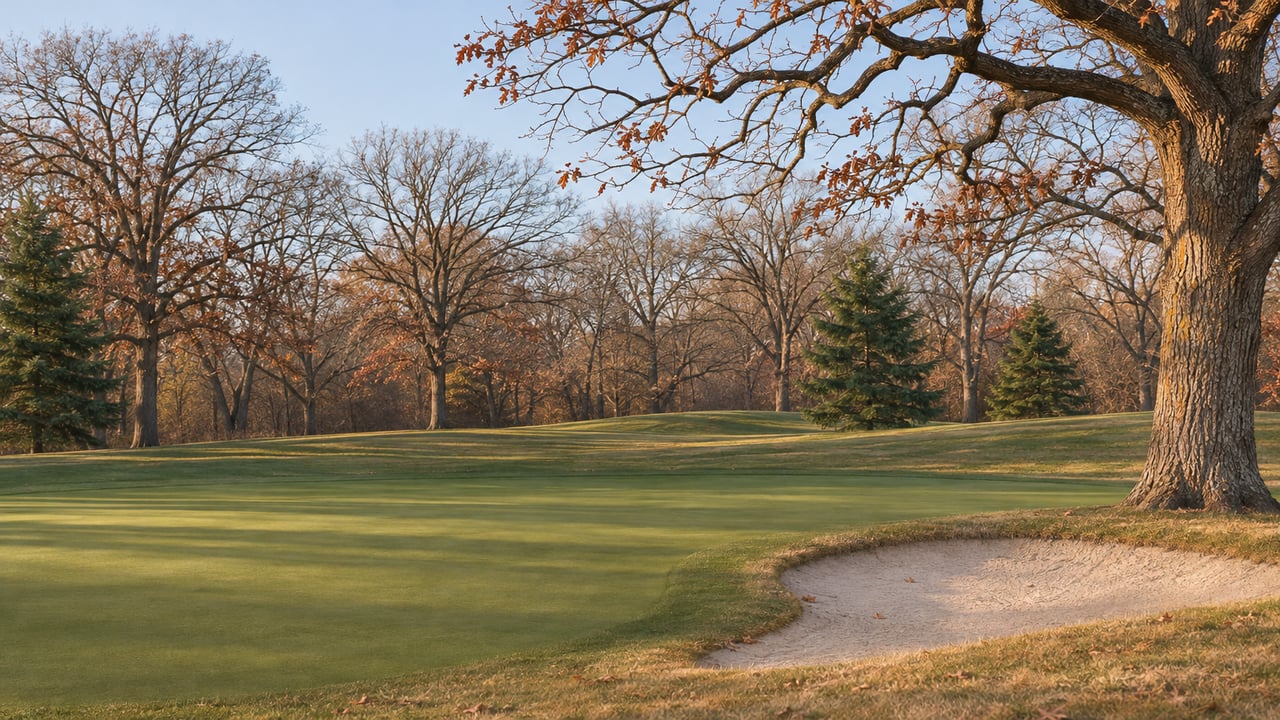
The remaining nine holes are now Vernon Hills Golf Course at 291 Evergreen Drive. It is a daily-fee course owned by the Village and managed by KemperSports. Architect Dick Nugent redesigned it, and a new clubhouse opened in 1996. The course has narrow fairways and small greens, and a creek comes into play on seven holes. The clubhouse restaurant and bar is called The Cafe at The Muni. It serves lunch all day and has an outdoor pavilion where you can watch golfers finish their rounds.
The clubhouse stays in use after the golf season. American Legion Post 1247 runs bingo there on the second Thursday of each month from October through April. Games start at 6:30 p.m., and food and drinks are for sale. The remaining dates are December 10, January 14, February 11, March 11 and April 8, and proceeds support the post's charitable work. Forest Court, Forest Way and Oak Forest Lane, the town's first streets, are just south of Route 45 near the course.
The golf course gave Vernon Hills its name. A shopping center made it a town, and that land was meant to go to Libertyville.
In August 1970, Urban Investment & Development Co. asked Libertyville to annex 591 acres north of Route 60. The land was part of John Cuneo's holdings. The plan was New Century Town, a $250 million planned community expected to add 15,000 to 18,000 residents, with Hawthorn Center, a 1.3-million-square-foot shopping center, at its heart. Libertyville argued about it all winter. A group called the Citizens Right to Vote Committee pushed for a referendum, even though the company had indicated it would withdraw if the annexation went to a vote. On February 4, 1971, it withdrew. The library's history quotes Libertyville's lawyer, Willis Overholser, calling it "the worst disaster that ever happened in Libertyville."
The same day, Vernon Hills village president John Sullivan announced that Urban Investment had sent his board a proposed pre-annexation agreement. Vernon Hills annexed the 591 acres on April 6, 1971, and construction started that year. Hawthorn Center opened on September 10, 1973. It had brick-paved halls and old-fashioned street lights meant to "simulate shopping streets of Europe," and 140 stores, including Marshall Field, Sears, Montgomery Ward and Lord & Taylor. The mall brought 2,000 to 3,000 jobs and more than $1 million a year in sales tax. By 1980 the village had 9,827 residents, almost ten times its 1970 count.
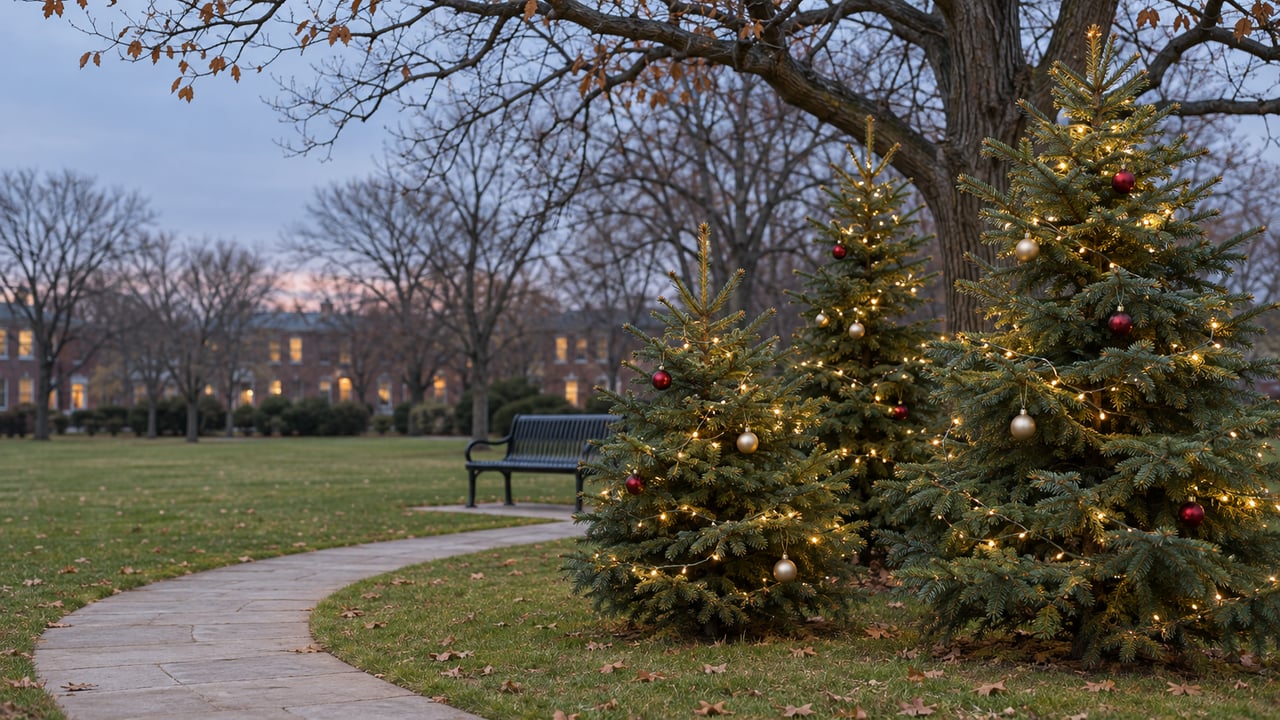
More than fifty years later, the mall is getting a new role in village life. The Village has moved its holiday lighting to the Hawthorn Row area of Hawthorn Mall, next to Yard House, describing the new spot as more visible and accessible. The celebration is Saturday, November 28, from 4 to 7 p.m., with the tree lighting at 5 p.m. Santa arrives with Countryside Fire, and there will be hot cocoa, a giant inflatable gingerbread slide, ice skating and vendors. The mall is still part of the Village's plans in other ways too: the Hawthorn Mall Redevelopment TIF, created in 2019, remains active.
Hawthorn Center was built on Cuneo land, and most of the later growth came from the same family's holdings. Their story starts with Chicago businessmen who farmed as a hobby. Samuel Insull owned Hawthorn Farm. Next door, Joseph Medill Patterson built Westwood in 1906, a red-brick Federal-style mansion at Townline Road and Milwaukee Avenue designed by Howard Van Doren Shaw. Patterson later founded the New York Daily News. After Patterson died in 1946, his daughter Josephine sold Westwood to John Cuneo Sr., who had already bought Hawthorn Farm from Insull's estate. Westwood was the headquarters of Hewitt Associates from 1951 until the company moved to Deerfield in 1971, and the mansion was then torn down.
Cuneo parcels annexed in the late 1980s eventually became the Gregg's Landing neighborhoods. Gregg's Landing North covers 813 acres between Milwaukee Road and Butterfield Road at the north end of the village. Construction started around 1997, and the association lists about 1,305 properties in 20 neighborhoods. The neighborhoods are named after famous golf courses, including Inverness, Oakmont, Muirfield Village, Pebble Beach, St. Andrews, Royal Troon and Torrey Pines. Like the old Tally Ho, the area is built around a course. White Deer Run Golf Club is a public course with online tee-time booking. The neighborhood association lists Hawthorn Mellody Park, Lake Charles Park and a passive park near the 17th tee among its parks, and the two lakes of Century Park border it to the south.
The mansion the family kept is now owned by the Village. On September 10, 2025, the Village announced that it was acquiring Cuneo Mansion & Gardens from Loyola University Chicago under a 2015 Preservation Agreement, with the transfer expected in January 2026. Loyola's financial statements for the year ended June 30, 2026, record the transfer. In the Village's announcement, Village President Thom Koch Jr. said the Village had no plans yet for the property and that "further evaluation will take place following the formal transfer to determine the best path forward in a manner that reflects both the community's interests and the property's legacy." The Daily Herald reported at the time that couples who had booked weddings were told no events would be held after December 15, 2025.
Some of the estate has already been built on. Loyola sold the northern 53 acres in 2017 for a 128-home subdivision, the Daily Herald noted. The Village's association directory lists a single-family neighborhood called Cuneo Residences with 128 homes.
Two of the three places have dates on the calendar this season. The tree lighting at Hawthorn Row is Saturday, November 28. The Muni clubhouse on Evergreen Drive hosts Legion bingo on December 10. On the way, you can drive the three short streets near Route 45 where the twenty first homes went up in 1957. For more on where Vernon Hills eats now, see our look at the restaurants on Milwaukee Avenue, and the Vernon Hills neighborhood page has the rest of the town.
A home's address in Vernon Hills often tells you which part of this history it belongs to: the streets L&H built, the subdivision on Tally Ho's old western nine, or the Gregg's Landing neighborhoods on former Cuneo land. If you're curious what that history means for your own home today, Cornelia Matache is happy to talk it through, with no pressure and in English or Romanian. Start with a complimentary home valuation and expert consultation.
Stay up to date on the latest real estate trends.
Reach out to explore your goals. I’m here to offer insight, professionalism, and a refined real estate experience.